

You are standing in your driveway, staring at a season’s worth of grime on the concrete. Your car is coated in road salt, and the patio furniture looks like it survived a dust storm. You need a pressure washer, and you have narrowed it down to two heavyweights: Karcher and Bosch. Both brands promise powerful cleaning, but which one delivers the best value for your home in 2026? This guide compares the top Karcher models, from the compact K 1 to the beastly K 3000 E, to help you decide if Karcher is the right choice over Bosch for your specific tasks. We have evaluated nine Karcher pressure washers to give you a clear picture of what each offers. For more on electric options, check out our guide on the best electric pressure washer for the money.




Buying Guide
Pressure and Flow Rate: PSI and GPM
The two most critical specs for any pressure washer are PSI (pounds per square inch) and GPM (gallons per minute). PSI determines cleaning power, while GPM affects how quickly you can rinse away dirt. For home use, a PSI between 1700 and 2300 is usually sufficient for driveways, patios, and cars. The Karcher K 3000 E, for instance, delivers a massive 3000 PSI for heavy-duty stripping, while the K 1 offers a more modest 1700 PSI for lighter tasks. A higher GPM, like 1.4 or 1.45, speeds up cleaning on larger surfaces.
When comparing Karcher to Bosch, look at both numbers. Karcher’s CETA-certified models, such as the K1700 and K1900PS, provide verified performance you can trust. For more on choosing the right power, read our best karcher pressure washer for home use article.
Motor Type: Induction vs. Universal
The motor is the heart of any electric pressure washer. Karcher uses two main types: brushless induction motors and universal motors. Induction motors, found in models like the K 5 Premium and K2300PS, last longer, run quieter, and are more efficient. Universal motors are cheaper but wear out faster. If you plan to use your pressure washer frequently, an induction motor is a worthwhile investment. The K 3000 E also features a durable induction motor for extended lifespan.
Bosch pressure washers often use universal motors, which can be noisier and less durable. For heavy use, Karcher’s induction motor models give you an edge. This is especially important for those who clean multiple cars or large driveways regularly.
Nozzles and Spray Options
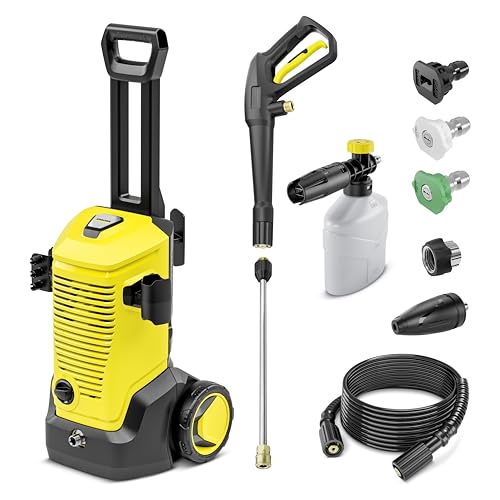
Versatility in spray patterns is key for tackling different surfaces. Most Karcher models come with multiple nozzles. The K2300PS includes four quick-connect nozzles (15°, turbo, 40°, and soap), while the K 5 Premium features a Vario Power spray wand and a Dirt Blaster wand. The turbo nozzle is excellent for stubborn stains on concrete, and the soap nozzle is perfect for car washing. The K 3000 E goes a step further with a five-nozzle set for precision cleaning.
Bosch models typically include fewer nozzle options. If you need flexibility for different cleaning jobs, Karcher’s range of nozzles gives you more control. For car enthusiasts, a foam cannon is a bonus, as seen in the K 5 FC model.
Portability and Storage
If you have limited storage space, consider the size and weight of the pressure washer. The Karcher K 1 weighs just 9.8 pounds and is compact enough to store in a small shed or closet. Larger models like the K2300PS and K 5 Premium feature hose reels and folding handles for easier storage and transport. Wheels are also important for maneuverability; the K1900PS and K1700 have never-flat wheels that glide over rough terrain.
Bosch pressure washers are generally bulkier. For those who need to move the unit around a large property, Karcher’s wheeled designs are a clear advantage. Check out our guide on best wall mounted electric pressure washer for space-saving ideas.
Final Thoughts
Choosing between Karcher and Bosch ultimately comes down to your specific needs. For most homeowners, the Karcher Pressure Washer K 5 offers the best balance of power, durability, and convenience with its induction motor and hose reel. If you need a compact, budget-friendly option for light cleaning, the Karcher Pressure Washer K 1 is a fantastic choice that won’t take up much space. Both models deliver the reliable performance Karcher is known for, making them strong contenders against any Bosch pressure washer.
Frequently Asked Questions
What is the main difference between Karcher and Bosch pressure washers?
Karcher pressure washers generally offer more advanced motor technology, such as brushless induction motors, which provide longer life and quieter operation. Bosch models often use universal motors. Karcher also provides a wider range of nozzle options and CETA-certified performance ratings.
Can a Karcher pressure washer clean my car safely?
Yes, many Karcher models are safe for car washing. Use a wide-angle nozzle (like 40° or soap) and keep the nozzle moving to avoid damaging the paint. The K 2 Power Control and K 5 Premium both have adjustable spray wands for gentle cleaning. Always use a car-specific detergent for best results.
Which Karcher pressure washer is best for a large driveway in 2026?
For large driveways, we recommend the Karcher Pressure Washer K2300PS or the K 3000 E. The K2300PS delivers 2300 PSI with a hose reel for easy maneuvering, while the K 3000 E offers 3000 PSI for heavy-duty stripping. Both feature induction motors for durability. For more on driveway cleaning, see our best electric pressure washer for the money guide.
How long do Karcher pressure washers typically last?
With proper maintenance, Karcher pressure washers with induction motors can last 5 to 10 years or more. Universal motor models may have a shorter lifespan. Regular descaling and proper storage extend the life of any pressure washer.


