
You’ve just pulled into your driveway after a long week, and your car is caked with road grime. Or maybe you’re staring at a mossy patio that needs a serious deep clean. You’ve narrowed your search to two big names: Karcher vs Ryobi pressure washer. Both brands have loyal followings, but they take different approaches to electric cleaning power. This guide breaks down the key differences, so you can pick the right machine for your driveway, deck, and vehicle without second-guessing yourself.



Before you commit to a brand, you need to understand what makes an electric pressure washer effective. It’s not just about peak PSI numbers. You have to look at water flow, build quality, and how easy the machine is to move around your property.
Power and Flow: PSI and GPM Explained
PSI (pounds per square inch) measures the pressure, while GPM (gallons per minute) measures the water volume. Together, they determine cleaning power. A higher PSI blasts away tough grime, but a higher GPM rinses faster and helps soap work better.
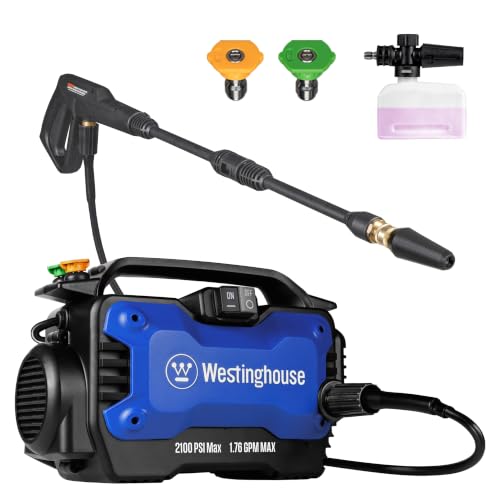
For example, the Westinghouse ePX3500 delivers 2500 max PSI and 1.76 max GPM, which is excellent for heavy-duty jobs like driveways. In contrast, the Kärcher K1700 offers 1700 PSI and 1.2 GPM, which is plenty for cars and patios but not as aggressive. If you need raw power, look for a model with higher numbers in both categories.
Portability and Storage
Electric pressure washers are already lighter than gas models, but there are still big differences in portability. The Westinghouse ePX3100s weighs just 10 pounds and has a built-in handle, making it a true grab-and-go option. The Kärcher K1700 features never-flat wheels for smooth rolling over uneven ground.
If you have a small garage or limited storage, a compact model with integrated hose and nozzle storage is a game-changer. Look for units with onboard holders for the wand, nozzles, and cord to keep everything tidy.
Accessories and Versatility
Most electric pressure washers come with a few nozzles, but the range varies. The Kärcher K1700 includes three nozzles (15°, turbo, and 65°) and a detergent tank. The Westinghouse ePX3500 steps it up with a five-nozzle set, including a turbo nozzle and a soap applicator.
If you already own a pressure washer, you might be looking for replacement parts. The GRESTOAL Pressure Washer Gun and the PWACCS Pressure Washer Gun Replacement are both compatible with Karcher and Ryobi models, giving you more flexibility without buying a whole new unit.
Build Quality and Durability
You want a machine that lasts. Kärcher is known for its German engineering and reliable components. The K1700 has a robust frame and a foot switch that’s easier on your back. Ryobi models are built with durable materials and are designed for regular use.
Also, consider the warranty. Westinghouse offers a 3-year limited service, labor, and parts coverage, which is a solid safety net. Always check the warranty terms before making a final decision.
Final Thoughts
In the battle of Karcher vs Ryobi pressure washers, there’s no single winner, it all depends on your priorities. If you want maximum power and a comprehensive accessory package, the Westinghouse ePX3500 Electric Pressure Washer is a standout with its 2500 PSI and five nozzles. For a lighter, more budget-friendly option that still delivers solid performance, the Westinghouse ePX3100s Electric Pressure Washer is a fantastic choice, especially for quick car washes and patio cleanups. Both are excellent, but they serve different needs, so pick the one that matches your typical cleaning tasks.
Frequently Asked Questions
What is the main difference between Karcher and Ryobi pressure washers?
Karcher focuses on compact, efficient designs with certified performance, while Ryobi often emphasizes raw power and a wider range of accessories. For example, the Kärcher K1700 is CETA certified for reliable pressure, whereas Ryobi models like the Ryobi Automotive Pressure Washer are built specifically for vehicle cleaning.
Can I use Karcher accessories on a Ryobi pressure washer?
Yes, many accessories are cross-compatible. The GRESTOAL Pressure Washer Gun and the PWACCS Pressure Washer Gun Replacement are designed to fit both Karcher and Ryobi models, as well as Greenworks and PowerStroke. Just check the fitting type (usually M22-14mm) and the PSI rating to ensure compatibility.
Which pressure washer is better for washing cars?
For cars, you want a lower PSI to avoid damaging paint, but enough GPM to rinse effectively. The Ryobi Automotive Pressure Washer is tailored for vehicles, while the Kärcher K1700 with its 65° nozzle is also gentle enough. Both are good, but if you want a dedicated car wash, the Ryobi is a solid pick.
Are electric pressure washers powerful enough for driveways?
Yes, many electric models can handle driveways. Look for a unit with at least 2000 PSI and a turbo nozzle. The Westinghouse ePX3500 is a prime example, delivering 2500 max PSI and a turbo nozzle to blast away stubborn stains. For more heavy-duty tasks, you might also consider a gas-powered unit, but electric is often sufficient for residential use.