

You need a reliable way to blast away grime from your driveway, patio, and car without spending hours scrubbing. Whether you are tackling stubborn mud on a fence or preparing a deck for staining, the right electric pressure washer can transform a tedious chore into a quick, satisfying task. This guide reviews ten top models, focusing on power, portability, and ease of use, helping you find the best pressure washer for your home cleaning projects. For a broader selection, explore our complete pressure washer collection.





Buying Guide: Choosing Your Ideal Electric Pressure Washer
Power and Performance: PSI and GPM
Pressure washer effectiveness is measured by PSI (pounds per square inch) and GPM (gallons per minute). Higher PSI means more cleaning force, while higher GPM means faster rinsing. For most home jobs like cleaning cars, patios, and driveways, a model with 2000 to 2500 max PSI and 1.7 to 2.0 max GPM offers a great balance. The Westinghouse ePX3500 delivers 2500 max PSI, ideal for tougher stains, while the compact Westinghouse ePX3050 provides 2100 max PSI for lighter tasks.
Consider the type of surfaces you clean most. Delicate items like car paint require lower pressure settings, whereas concrete driveways benefit from higher force. Many units include adjustable nozzles to vary the spray pattern, giving you control over the cleaning intensity.
Portability and Storage
Electric pressure washers are generally lighter than gas models, but weight and wheel design still matter. Look for units with large, never-flat wheels and a compact frame for easy movement around your property. The Westinghouse ePX3100 features four quick-lock wheels with 360-degree steering and a low center of gravity to prevent tipping. For storage, models with cord hooks, nozzle holders, and a compact footprint, like the LWQ Portable Power Washer, are excellent for garages or pantries.
Included Accessories and Versatility
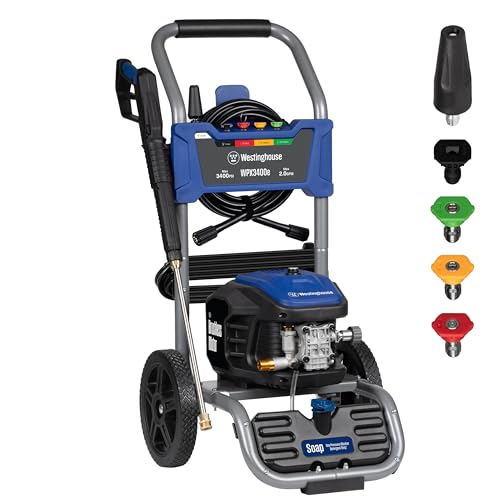
Most pressure washers come with a set of quick-connect nozzles (0°, 15°, 25°, 40°) and a foam cannon or soap tank. These accessories let you switch from heavy-duty stripping to gentle washing. Models with onboard soap tanks, such as the Westinghouse ePX3500 or WPX3400e, simplify adding detergent without an extra bottle. A long, kink-resistant hose (20 to 25 feet) and a 35-foot power cord provide ample reach without constantly moving the unit. For more details on electric models, visit our electric pressure washer category.
Motor Type and Durability
The motor and pump are the heart of any pressure washer. Brushless motors, like the one in the Greenworks 3000 PSI model, offer longer life and quieter operation compared to brushed motors. Axial cam pumps with auto-stop features, found on many Westinghouse units, automatically shut off the pump when the trigger is released, saving energy and extending component life. A robust steel frame, as seen on the Westinghouse WPX3400e, adds stability and longevity for frequent use.
Final Thoughts
After reviewing these ten electric pressure washers, the best choice depends on your primary cleaning needs: for a compact, highly portable option with excellent versatility for cars and light home tasks, the Pressure Washer, Portable Power Washer by LWQ stands out with its easy rolling design and multiple nozzles, while for heavier-duty jobs like large driveways and patios, the Westinghouse ePX3500 Electric Pressure Washer delivers robust power with a stable anti-tipping frame and an onboard soap tank, making it a reliable workhorse for any homeowner.
Frequently Asked Questions
What PSI do I need for a pressure washer?
For most home tasks like cleaning cars, patios, and driveways, a pressure washer with 2000 to 2500 PSI is sufficient. Higher PSI, around 3000, is better for stubborn stains on concrete or heavy-duty cleaning. Lighter tasks like washing a car can be done with 1500 to 2000 PSI using a wide nozzle.
Can I use a pressure washer with a bucket of water?
Yes, many electric pressure washers, including the LWQ Portable Power Washer, feature a faucet or bucket water collection system. This allows you to draw water from a bucket or other container, which is ideal for areas without a garden hose connection. Ensure the water supply is clean and free of debris to protect the pump.
How do I maintain my electric pressure washer?
After each use, disconnect the water and run the machine briefly to expel any remaining water from the pump and hose. Store it in a dry, frost-free location. Periodically check and clean the inlet filter to prevent clogs. For models with auto-stop pumps, ensure the trigger is released when not in use to prolong pump life.
What is the difference between an electric and gas pressure washer?
Electric pressure washers are quieter, lighter, and require less maintenance than gas models. They are ideal for light to medium-duty tasks around the home and are easier to start and store. Gas pressure washers, like the Westinghouse WPX3400 Gas model, offer higher PSI and GPM for heavy-duty commercial-level cleaning but are louder and need fuel and oil changes.
